Turning Scientific Papers into Interactive AI Agents That Answer Questions and Run Analyses
Research papers have always been passive objects. A reader finds one, parses its methods, and then faces the real work: locating the code repository, installing dependencies, configuring environments, and figuring…

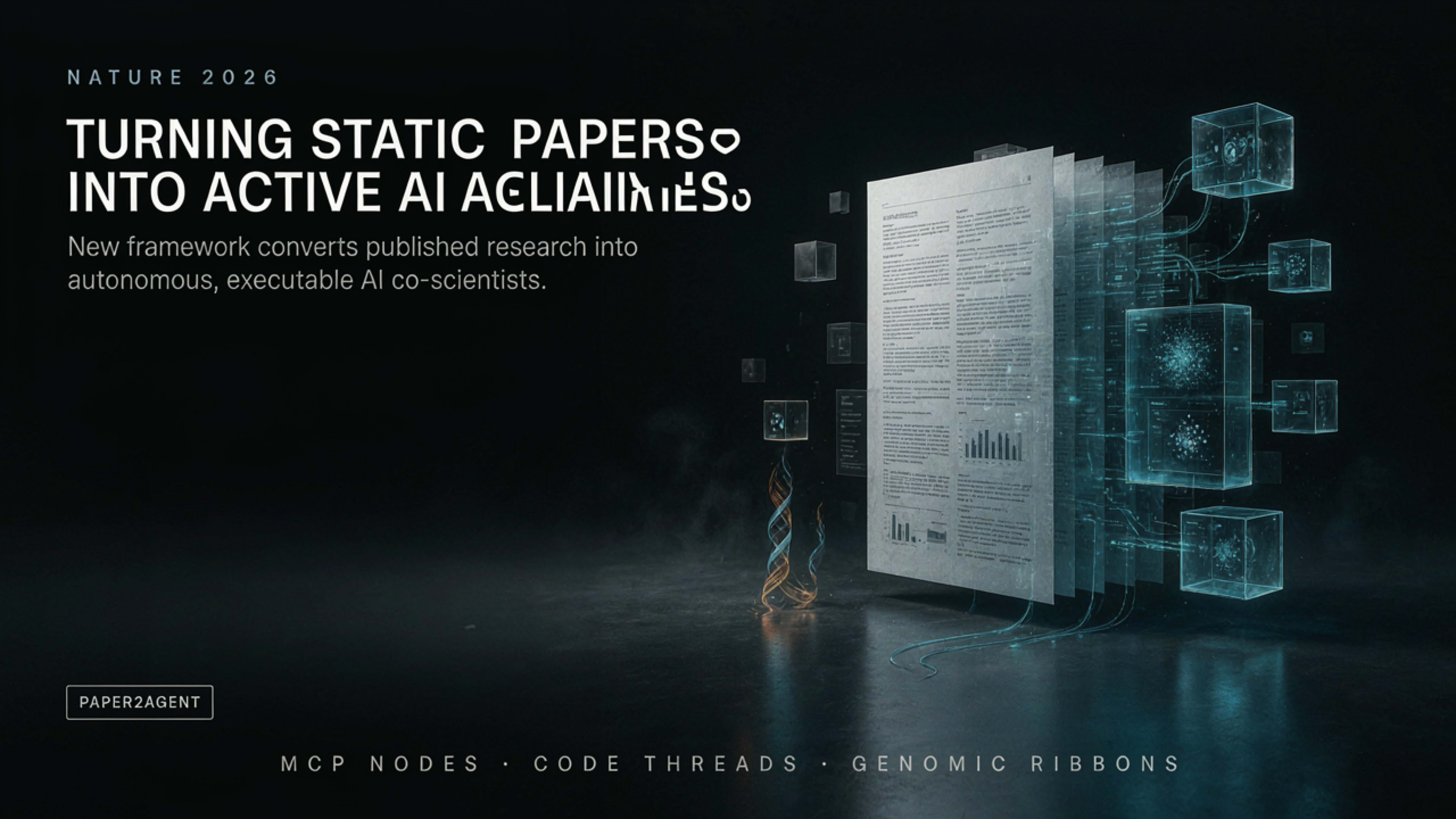
Research papers have always been passive objects. A reader finds one, parses its methods, and then faces the real work: locating the code repository, installing dependencies, configuring environments, and figuring out how to apply the described approach to a different dataset. For a computational method like AlphaGenome—a powerful framework for genome-scale foundation modeling—this process demands substantial technical expertise before a biologist can even begin to use it. Paper2Agent addresses this gap by transforming static papers into interactive AI agents.
The framework converts a research paper and its associated codebase into a Model Context Protocol (MCP) server, which exposes the paper’s methods, data, and workflows as executable tools rather than static text. A user can then connect this server to a chat agent and ask questions in plain language: “Interpret this variant’s effect on chromatin accessibility in muscle cells,” for instance, instead of cloning repositories and debugging installation issues.
Six-Step Pipeline
Paper2Agent operates through a six-step pipeline orchestrated by specialized sub-agents. First, it locates and downloads the associated codebase. Second, it sets up a clean virtual environment for the repository. Third, it scans for tutorials and educational materials. Fourth, it executes those tutorials end-to-end to capture reference outputs. Fifth, it extracts reusable tools from the executed tutorials and validates them against the tutorial results—tools that repeatedly fail validation are excluded. Sixth, it assembles the validated tools into a production-ready MCP server with structured resources including the manuscript text, codebase, and supplementary materials.
MCP Server Architecture
Each generated MCP server contains three core components. MCP tools are executable functions that encapsulate a paper’s methodological contributions. MCP resources serve as a repository of static assets in standardized formats. MCP prompts encode multi-step workflows derived from the paper’s text or codebase, guiding agents through complex analyses in the correct sequence.
AlphaGenome Case Study
The researchers demonstrated Paper2Agent‘s capabilities through several case studies. Applied to the AlphaGenome paper, the system generated 22 MCP tools—covering single- and batch-variant scoring, sequence-level prediction, tissue ontology exploration, and visualization—in approximately 45 minutes at a cost of $14 on a personal laptop. All 22 tools passed automated validation.
When benchmarked against 15 tutorial-derived queries and 15 novel queries, the AlphaGenome agent achieved 98.7% accuracy on tutorial tasks and 100% accuracy on novel tasks, outperforming Claude Code with direct repository access (82.7% and 78.7% respectively) and Biomni (37.3% and 56.0%). On 30 open-ended researcher-style queries requiring multi-step tool composition, Paper2Agent reached 82.7% accuracy compared to 56.7% for Claude + Repo and 72.2% for Biomni. The agent also reduced median runtime by 1.9x to 3.8x depending on query type.
One revealing example involved the variant chr1:109274968:GT, associated with low-density lipoprotein cholesterol. The AlphaGenome agent prioritized SORT1 as the most likely causal gene based on two factors: a high quantile score (0.99983) indicating strong predicted impact on SORT1 expression in liver tissue, and SORT1’s known role in lipid secretion. GTEx eQTL data confirmed the variant as significant for SORT1 (P = 1.1 × 10⁻⁶⁵). This differed from the original paper’s emphasis on CELSR2 and PSRC1—results that highlight the inherent difficulty of assigning causal genes at complex GWAS loci where variants affect multiple nearby genes.
Scanpy Application
Applied to the Scanpy package for single-cell analysis, Paper2Agent generated seven tools covering quality control, filtering, normalization, feature selection, dimensionality reduction, clustering, and cell-type annotation. The system encoded the complete preprocessing and clustering pipeline through MCP prompts, so users only needed to provide a data path and the agent would execute the workflow in the correct order. Evaluation across seven diverse single-cell datasets showed the agent adaptively adjusted parameters based on data characteristics while producing outputs matching those from human researchers.
Large-Scale Evaluation
A large-scale evaluation processed three heterogeneous corpora end-to-end without manual intervention: 100 computational biology papers from bioRxiv, 26 data- and discovery-focused papers, and 10 non-biology computational papers spanning econometrics, game theory, astrophysics, and other fields. Of the 100 computational biology papers, 74 were successfully agentified, yielding 593 validated tools from 599 proposed tools. On 300 tutorial-based benchmark questions, Paper2Agent with Sonnet 4 achieved 91.2% accuracy, outperforming Claude Code with direct repository access using Sonnet 4 (80.3%) and Sonnet 4.6 (86.3%), while reducing per-query cost from $0.38 to $0.20 and latency from 4.3 minutes to 1.6 minutes.
Among the 26 data- and discovery-focused papers, the resource layer achieved 89.0% accuracy on synthesis-based questions, outperforming a Claude browser-use baseline (82.0%) while being 34 times cheaper and 15 times faster. On 42 execution-based tasks from non-biology computational papers, Paper2Agent achieved 98.1% accuracy. Adversarial tests showed the system could recover functional MCP servers even when injected with missing dependencies, broken file paths, typographical errors, and deprecated API calls.
Multi-Agent Discovery
Perhaps most significantly, Paper2Agent enabled multiple paper agents to collaborate on discovery. Using three agents—for AlphaGenome, an MPRA-coupled sRISCRi screen, and a CD4+ T cell Perturb-seq dataset—the system identified and validated GPR137 as the probable causal gene for a psoriasis-associated variant. The AlphaGenome agent predicted GPR137 as the top affected gene (RNA-seq quantile score: 0.997). An AI co-scientist then cross-referenced this prediction with experimental data from the other two agents, proposing candidate strategies for validation. The selected approach correlated downstream expression changes from cis-regulatory element perturbation with those from gene knockdown. Only GPR137 knockdown showed significant concordance with the perturbation signature under stimulated conditions (Spearman correlation: 0.613, P = 3.79 × 10⁻³ at Stim8hr; 0.630, P = 4.71 × 10⁻³ at Stim48hr; FDR = 0.05), while BAD knockdown and other candidates showed no significant correlation. The effect appeared only under stimulation, suggesting GPR137’s role at this locus is activation-dependent—a pattern consistent with the established involvement of activated CD4+ T cells in psoriasis.
Implications for Scientific Publishing
Paper2Agent represents a shift in how scientific knowledge is represented and reused. Papers become agent-native research objects capable of dialogue, execution, and collaboration rather than static documents. The researchers acknowledge that not every paper can be seamlessly transformed into a robust agent—some lack executable code, data artifacts, or have unresolvable environment configurations. They suggest that the ease of agentification may itself serve as a practical measure of reproducibility, analogous to data and code availability requirements.
The framework remains a tool for augmenting discovery rather than replacing human judgment. Open-ended scientific reasoning, hypothesis generation, and mechanistic interpretation remain human-in-the-loop. The researchers anticipate that “agent availability” sections may eventually accompany papers, specifying how contributions have been embodied as interactive agents—similar to how data and code availability sections are now standard.
Paper2Agent is publicly available at https://github.com/jmiao24/Paper2Agent. Generated MCP servers for AlphaGenome, Scanpy, and TISSUE are hosted on Hugging Face Spaces, enabling immediate access to these paper agents without local environment setup.